You know the feeling. Walk away from a print, come back an hour later, and it’s spaghetti because the first layer let go 20 minutes in.
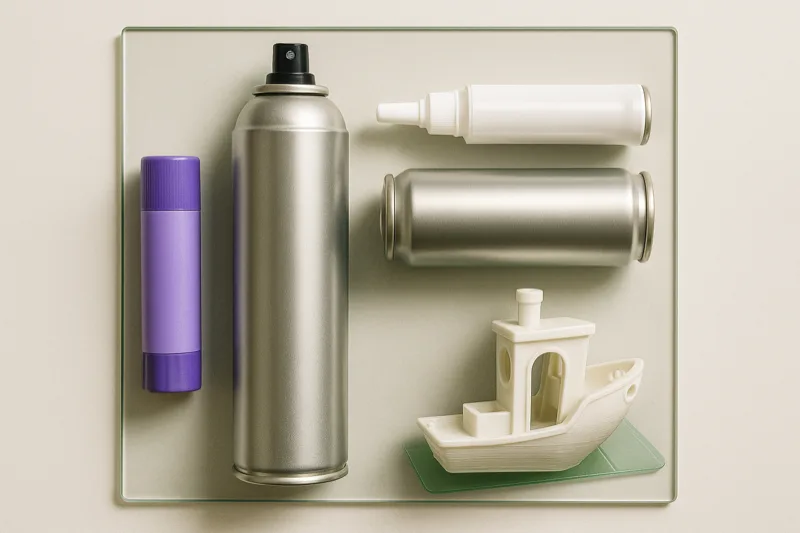
I’ve lost count of how many prints I’ve ruined that way. So over the past year, I bought every adhesive I could get my hands on and ran them all through my printers. Dedicated formulas, glue sticks, hairspray, PEI sheets, weird stuff from Reddit threads. These 10 are the ones that actually held up.
A few are purpose-built products from 3D printing companies. Others are cheap household items the community figured out years ago. They all do the same thing though: keep your print stuck to the bed until the job is done.
Quick Comparison Chart
| # | Product | Our Rating | ||
|---|---|---|---|---|
| 1 |  |
Magigoo Original | ★★★★★ | Check Price |
| 2 |  |
Elmer's Disappearing Purple Glue Stick | ★★★★★ | Check Price |
| 3 |  |
3DLAC Adhesive Spray | ★★★★★ | Check Price |
| 4 |  |
Layerneer Bed Weld | ★★★★★ | Check Price |
| 5 |  |
Vision Miner Nano Polymer | ★★★★★ | Check Price |
| 6 |  |
Aqua Net Extra Super Hold | ★★★★★ | Check Price |
| 7 |  |
Gizmo Dorks PEI Sheet | ★★★★★ | Check Price |
| 8 |  |
Dimafix Adhesive Pen | ★★★★★ | Check Price |
| 9 |  |
Wolfbite Mega | ★★★★★ | Check Price |
| 10 | |
Layerneer Bed Weld Original | ★★★★★ | Check Price |
1. Magigoo Original — Best Overall
Magigoo Original
I use this on basically everything. PLA, PETG, ABS, HIPS, TPU, glass beds, PEI, flex plates, BuildTak. One pen, no formula swapping, no fuss.
Pros
- Handles PLA, PETG, ABS, HIPS, and TPU with a single formula so you're not juggling bottles
- Parts let go on their own once the bed drops below 50C
- You'll get 100+ applications from one 50mL pen, which makes the per-print cost basically zero
Cons
- Higher upfront price than a pack of glue sticks
- Leave the cap off and the pen tip dries out fast
Magigoo got the top spot because I haven’t found anything it can’t handle. PLA, PETG, ABS, TPU flexibles. I don’t switch products anymore, I just grab the pen and go.
Using it is about as simple as it gets. Shake, press the felt tip to the bed, swipe across your print area. Thin wet coat, and you can start printing right away. No drying time, no layering multiple coats.
The auto-release feature is what won me over. Bed cools below 50C and the part just lets go. I’ve come back to finished prints sitting loose on the plate, ready to pick up. Wipe the bed with a damp cloth and you’re set for the next one.
If you print different filaments on the same machine and you’re tired of keeping a whole shelf of adhesive products, just get this. It’s a must-have 3D printer accessory in my shop and I’d buy it again without thinking.
2. Elmer’s Disappearing Purple Glue Stick — Best Budget
Elmer's Disappearing Purple Glue Stick
There's a reason every forum recommends these. Goes on purple so you can see your coverage, dries clear, and warm water cleans it right off. Costs almost nothing and every grocery store sells them.
Pros
- Literally pennies per print and you can grab them at any store with a school supplies aisle
- Purple tint shows you exactly where you've applied, then fades to clear as it dries
- Warm water washes the PVA formula right off so your bed stays clean
Cons
- You'll be reapplying every 3 to 5 prints depending on how hot your bed runs
- Go too thick and you get clumps that telegraph through to your first layer
Every 3D printing forum on the internet recommends Elmer’s purple glue sticks, and honestly? They’ve earned it. Costs nothing, works on PLA and PETG, and you can grab one at literally any store that sells school supplies.
The purple tint is more useful than it sounds. On a clear glass bed, you can actually see where you’ve covered and where you missed. The color disappears as it dries, leaving a thin tacky film.
I still keep a pack of these at every printer station even though Magigoo is my primary. For PLA on glass, they work just as well as products that cost five times more. You’ll need to re-coat every few prints though, which is the main tradeoff.
If you’re just getting started with 3D printing and don’t want to spend money figuring out adhesion, grab a pack of these first. You can always upgrade later.
3. 3DLAC Adhesive Spray — Best Spray
3DLAC Adhesive Spray
An actual spray adhesive made for 3D printers, not repurposed hairspray. Coats the entire bed evenly in a couple seconds, grips PLA, ABS, and PETG well, and washes off with water.
Pros
- Two quick passes and your entire build plate has an even coat of adhesive
- Made specifically for 3D printing so the grip-to-release balance is already dialed in
- A single 400mL can goes for months, even if you're printing daily
Cons
- The overspray is real, so pull the bed off or use a shield before spraying
- It's an aerosol, so don't spray it in a tight room without cracking a window
This is what happens when someone actually makes a spray adhesive for 3D printers instead of telling you to buy hairspray. The formula grips at print temperature and lets go when cool, which is something hairspray only kinda sorta does.
Coverage is where this thing shines. One pass across the bed and you’ve got an even coat everywhere. No streaks, no thin spots, no globs. That matters a lot on bigger build plates where dragging a glue stick back and forth takes ages.
The 400mL can is bigger than it looks. Mine lasted about three months of regular use before I needed a new one. Do yourself a favor and pull the bed off before you spray though. Spray it over newspaper or in a cardboard box, not while it’s mounted in your machine.
If you’ve got a large-format printer and you’re sick of rubbing a glue stick across a 300mm+ bed, this is the obvious fix.
4. Layerneer Bed Weld — Best Premium
Layerneer Bed Weld
Serious liquid adhesive with a foam tip that puts down smooth, even coats. Grips hard at print temp, lets go once the bed cools. Wipe with a damp sponge between prints to reactivate.
Pros
- The foam tip gives you a smooth, drip-free coat every single time
- Thermal formula releases its grip at room temp so parts practically fall off
- Just wipe the existing coat with a damp sponge and it reactivates, saving product
Cons
- Only meant for glass beds running between 60C and 115C
- Pricier than the budget picks on this list
This is the one I tell people to get when they’re done fiddling with glue sticks and just want something reliable. The foam tip applicator sounds like a small detail, but it makes a huge difference. Smooth, even coat every time. No streaks.
The thermal formula is the whole point. Grips hard while the bed is hot, and the bond weakens as the glass cools. Your part lifts right off. No prying with a spatula, no scraping, no messed up first layers on your next print.
Here’s what really saves you money: you don’t reapply every print. Wipe the existing layer with a damp sponge and it reactivates. I’ve gotten 15 to 20 prints from a single application doing this, which makes one bottle last a really long time.
Veteran-owned company out of Palo Alto, and they built this from scratch for 3D printing. It shows. This isn’t some craft product that accidentally works on a print bed.
5. Vision Miner Nano Polymer — Best for Engineering Filaments
Vision Miner Nano Polymer
Made for the filaments that destroy other adhesives. Material scientists formulated this nano polymer to hold PEEK, PEI filament, polycarbonate, and nylon flat. Works on standard stuff too.
Pros
- Only adhesive on this list that actually keeps polycarbonate, nylon, and PEEK stuck down
- Non-toxic with barely any smell, so you can use it indoors without a respirator
- Safe on glass, PEI, Kapton, and metal build plates with no surface damage
Cons
- Costs way more per ounce than anything else here
- Total overkill if PLA and PETG are all you print
If you’re printing engineering filaments, you already know the struggle. Nylon warps like nothing else, polycarbonate rips itself off the bed mid-job, and PEEK? Forget it without proper adhesion. Vision Miner made this stuff specifically for those headaches.
Actual material scientists in Costa Mesa, California developed this formula. They spent close to a year working with engineers to nail the chemistry, and you can feel the difference. I printed polycarbonate parts that stayed flat through 6-hour jobs. That’s not something I can say about anything else on this list.
It’s non-toxic too, which I appreciate since high-temp filaments already throw off their own fumes. No reason to add more stuff to the air. Works on glass, PEI, Kapton tape, and metal build plates without hurting any of them.
This is for people printing functional parts with strong filaments where a failed print isn’t just annoying, it’s a waste of expensive material. If you’re only running PLA, save your money and get the Elmer’s.
6. Aqua Net Extra Super Hold — Best Hack
Aqua Net Extra Super Hold
The hack that kicked off a decade of 3D printing bed adhesion tricks. Cheap unscented hairspray, thin PVA film on glass, and one coat gets you through about 10 prints.
Pros
- A few bucks for a can that'll last months of daily use
- One light coat carries you through about 10 prints before you need another pass
- People have been doing this for over a decade so the technique is battle-tested
Cons
- Overspray coats your rails, frame, and anything else within two feet
- Can't handle high-warp filaments like ABS or nylon unless you've got an enclosure
This is the OG. Somebody in the early days of desktop 3D printing figured out that a quick hit of hairspray on glass gives PLA a perfectly sticky surface. Over a decade later, the trick still works and people still swear by it.
You want the Extra Super Hold Unscented specifically. Scented versions leave a nasty residue, and weaker hold strengths don’t grip enough. The unscented Extra Super Hold puts down a thin PVA film that holds PLA and PETG firmly and lets go cleanly once the bed cools.
Fair warning though: this is a hack, and it behaves like one. The overspray is no joke. Your linear rails, lead screws, frame, the desk behind the printer. All of it gets a fine mist coating. Either remove the bed before spraying or rig up a cardboard shield.
For PLA on glass, the value here is honestly hard to beat. But the moment you need something stronger for ABS or nylon, look at the purpose-built adhesives higher on this list.
7. Gizmo Dorks PEI Sheet — Best Sheet
Gizmo Dorks PEI Sheet
Forget liquid adhesives. This 1mm PEI sheet comes with 3M 468MP tape pre-applied on the back. Stick it to your bed and you've got built-in grip for PLA, PETG, and ABS.
Pros
- No more bottles, pens, or spray cans for most filaments
- 3M 468MP tape keeps the sheet dead flat on your bed with no bubbles if you install it carefully
- PLA and PETG grab on at temp and pop off with a light flex once the bed cools
Cons
- After a lot of prints you'll need to scuff the surface with fine sandpaper to refresh adhesion
- Might not match your build plate dimensions exactly, so have a utility knife ready
This is the “I’m done applying stuff to my bed” option. PEI naturally grips most common filaments without glue, spray, or anything else. Stick the sheet on and print directly on it for months.
Gizmo Dorks includes 3M 468MP transfer tape already on the back, which is the good stuff. It holds the PEI sheet perfectly flat against your build plate with no bubbling or corner lift. Takes about 10 minutes to install if you go slow and careful.
PLA on PEI is a match made in heaven. Parts grip at temp and release with a light tug or a flex of the plate once things cool down. PETG works too, but throw a thin layer of glue stick between the PETG and the PEI. Otherwise it can bond so hard it rips chunks out of the sheet.
Eventually the surface gets smooth from use and adhesion fades. Hit it with 2000-grit sandpaper and wipe with IPA to bring it back to life. With basic maintenance these sheets last a very long time.
8. Dimafix Adhesive Pen — Best Temperature-Activated
Dimafix Adhesive Pen
Grip scales with temperature. Barely holds below 60C, locks down hard above 75C. Really good for tricky ABS and ASA prints where the first layer needs to stay put no matter what.
Pros
- You can fine-tune grip strength just by adjusting your bed temperature
- Below 60C there's almost no bond, so finished prints practically slide off on their own
- Water soluble, so cleanup is just a quick pass with a damp cloth
Cons
- Stock is inconsistent in the US since it's a European product
- The pen tip frays after heavy use and gets sloppy
I think the temperature scaling on Dimafix is genuinely clever. Below 60C, barely any grip. Between 60 and 75C, moderate hold for simpler parts. Crank it above 75C and it locks things down hard enough for complex ABS with sharp corners and thin walls.
That temp response is basically a built-in release system. Print finishes, bed cools, part separates itself. No hovering over it with a spatula. I’ve had parts just sitting loose on a cooled bed, same as with Magigoo.
The pen holds 90mL, which works out to about 100 applications. It’s water soluble, so a warm damp cloth is all the cleanup you need. No solvents, no scraping, no gross buildup after weeks of use.
The downside? Availability. Dimafix is a European product and US stock goes in and out. When you can find it though, it’s one of the best things you can use for ABS and ASA on glass.
9. Wolfbite Mega — Best for PETG
Wolfbite Mega
Brush-on liquid that activates with bed heat and lets go once the plate cools. Handles PLA, PETG, ABS, TPU, and polycarbonate. Especially good at keeping PETG from fusing to your bed.
Pros
- PETG grips during printing but doesn't permanently weld itself to your build surface
- One 4oz bottle gets you 300+ applications, so it lasts an absurdly long time
- Zero grip at room temp means parts come off without any prying
Cons
- Glass beds only, so flex plate users need to look elsewhere
- Polycarbonate needs a few coats built up before it holds reliably
PETG is annoying. Not enough adhesion and it warps. Too much and it fuses to your build surface so hard you rip chunks out of your PEI sheet pulling the part off. Wolfbite Mega lands right in the middle where PETG holds firmly during printing but comes off clean once the bed cools.
Airwolf 3D made this in-house for their own industrial machines, and you can tell. Heat-activated, so it only grabs when the bed is hot. Room temperature? Zero grip. The included foam brush applies it easily and evenly.
The value on this bottle is kind of ridiculous. One 4oz bottle goes for 300+ applications. I’ve been using the same one for months and it’s still more than half full. Even at the higher sticker price, each print costs a fraction of a cent.
If PETG is your main filament and you run a glass bed, Wolfbite Mega handles the “stick but don’t fuse” problem better than anything else I’ve used. Works fine with PLA, ABS, and TPU too, but PETG is the reason to buy it.
10. Layerneer Bed Weld Original — Best for ABS
Layerneer Bed Weld Original
Same Bed Weld formula, but I'm highlighting it here for ABS and ASA specifically. Tested at bed temps up to 115C. Pair it with an enclosure and ABS warping becomes a non-issue.
Pros
- Keeps ABS and ASA pinned flat through multi-hour prints with zero corner lift
- Doesn't break down or lose grip even at 115C bed temps
- Water-soluble, so cleanup is just a wipe instead of scraping or solvents
Cons
- You really need an enclosure for consistent ABS results, which is extra cost
- It's the same bottle as #4, so you're not getting a different product here
Yeah, I’m listing Bed Weld twice. It earned a separate mention for ABS because that’s the filament everybody fights with. ABS contracts as it cools, yanking corners off the bed and warping flat surfaces. Bed Weld keeps it pinned.
What matters here is the thermal formula holding at 115C. ABS likes a hot bed, usually 90 to 110C, and a lot of adhesives start breaking down or bubbling up there. Bed Weld doesn’t. It held full grip through 8 and 10 hour prints in my testing without weakening.
Layerneer recommends an enclosure for ABS, and I’ll second that. The adhesive handles the first layer, but without an enclosure you’ll still get layer splitting and warping higher up from the temperature difference. Bed Weld plus an enclosure is the combo that actually works.
If you print ABS or ASA regularly and warping has been driving you nuts, try this setup. Bed temp around 100C, enclosed printer, Bed Weld on the glass. You’ll wonder what took you so long.
Buying Guide
Types of Bed Adhesion Products
There are a few distinct categories here, and they each do different things well. Knowing the differences saves you from buying the wrong product.
Glue sticks are the simplest and cheapest. PVA school glue sticks like Elmer’s go on fast, wash off with water, and work great for PLA and basic PETG.
Downside? You’re reapplying often and coverage can be uneven.
Spray adhesives coat large beds quickly and uniformly. 3DLAC and hairspray (Aqua Net) lay down an even layer in seconds. The tradeoff is dealing with overspray and needing some ventilation for the aerosol.
Liquid adhesives like Magigoo, Bed Weld, and Wolfbite are the premium tier. Built specifically for 3D printing, they last the longest per coat and work across the widest range of filaments.
More money upfront, but the per-print cost is actually tiny.
Build surface sheets like PEI skip liquids and sprays entirely. The surface material itself provides grip.
They’re clean and low-maintenance for standard filaments, but they do need occasional scuffing. And PETG can bond too hard to bare PEI if you’re not careful.
Matching Adhesive to Filament Type
Different filaments need different levels of grip. Pick wrong and your prints either fall off mid-job or bond so hard they damage your build plate.
PLA is easy. Almost anything sticks it down, including bare PEI with nothing on it. If PLA is all you print, a glue stick or hairspray is more than enough.
PETG needs grip without permanent bonding. That’s where Wolfbite Mega and Magigoo earn their money.
Running PETG on a PEI sheet? Always put a thin glue stick layer between them. Skip that step and you’ll rip chunks out of the PEI trying to remove your part.
ABS and ASA are the warping kings. They shrink aggressively as they cool and will pull themselves right off any surface without serious adhesion.
Bed Weld or Dimafix at 90 to 110C bed temp plus an enclosure is the standard approach. Same goes for printing food-safe filaments in ABS-based blends.
Nylon, polycarbonate, and PEEK are in another league. These engineering filaments need specialized adhesion, and that’s Vision Miner Nano Polymer territory.
Regular adhesives can’t hold up at the bed temps these materials demand.
Application Tips
How you apply the stuff matters almost as much as what you buy. Bad technique can make a great adhesive perform horribly.
Thin and even. Always. Thick glue stick globs create texture on your first layer. One smooth pass across the print area beats three heavy coats stacked on top of each other.
Apply to a warm bed. Spreading adhesive on a slightly warm surface (40 to 50C) helps it level out and dry evenly. Try rubbing a cold glue stick across cold glass. It drags and skips.
Clean before reapplying. Old adhesive layers get crusty and uneven over time. Every 5 to 10 prints, wash the whole bed with warm water and IPA, then start with a fresh coat.
This single habit makes more difference than most people realize.
Let sprays dry before printing. A wet spray coat bubbles the second the hot nozzle passes over it. Give it 30 seconds to flash off after spraying. Then start the print.
When You Don’t Need Adhesive
Sometimes you don’t need adhesive at all. Using it when you don’t have to just adds mess and cost for zero benefit.
Textured PEI sheets grip PLA on their own without anything extra. Most modern printers ship with one, and for PLA they’re a solved problem.
Wipe with IPA between prints. Done.
Smooth PEI at the right temperature holds PLA, PETG, and even ABS (with an enclosure) well enough for most jobs. The catch is your bed has to be clean. Fingerprint oils kill adhesion instantly.
Spring steel flex plates give you PEI adhesion plus the ability to flex the plate and pop parts off. If your printer supports one and you mainly print PLA, you probably don’t need any adhesive product.
The moment you should grab the adhesive is when you see corners lifting, first layers peeling, or parts detaching mid-print. That’s your surface telling you it needs help.
Frequently Asked Questions
Depends what you're printing. PLA on textured PEI? You're probably fine without it. But try ABS, nylon, or big flat PETG parts and you'll watch corners peel up within the first 30 minutes. I've got a glue stick sitting next to every printer in my shop because sooner or later you're gonna need one.
Yep, they actually work. Any PVA washable glue stick will do the job for PLA and PETG. I like the Elmer's purple ones because you can see where you've applied them, but the generic store brand works too. Just skip the glitter ones or anything scented. Basic washable school glue is what you want.
The dedicated stuff like Magigoo and Bed Weld can go 10 to 20 prints between fresh coats. Glue sticks and hairspray tap out faster, more like 3 to 5 prints. When you start seeing corners lift or your first layer looks rougher than usual, that's your sign to reapply.
Nope, not if you're using the right stuff. Glue sticks and water-soluble adhesives wash off PEI with warm water, no issues. Hairspray builds up a film over time, but IPA takes care of it. The one thing I'd stay away from is super glue or any random craft adhesive not made for printing. That stuff can bond permanently to your plate.
Each has a place. Glue sticks cost nothing and are easy to use, but you're reapplying constantly. Sprays coat big beds fast and evenly, but the overspray is annoying. Liquid adhesives last the longest and handle the most filament types. Personally, I grab a liquid for anything serious and a glue stick for quick PLA prints.
Classic over-application problem, or your bed temp is cranked too high. Walk away and let the bed cool all the way to room temp before you touch anything. Most thermal adhesives lose their grip once the plate drops below 40 to 50C. Still won't budge? Slide a thin flex spatula under one corner and gently work it free.
Big time. Warping is just the plastic shrinking as it cools, and that shrink force yanks the corners right off the bed. Adhesive fights that force and keeps everything pinned flat. For ABS and nylon, adhesive plus an enclosure is pretty much the only reliable way to prevent it.
That's the OG combo right there. Light coat on the glass, give it 30 seconds to dry, then print. Hairspray leaves a thin sticky film that PLA and PETG grip to nicely. Just take the bed off the printer before you spray. Trust me, you don't want that mist settling on your rails and electronics.
Final Thoughts
Nobody gets excited about bed adhesion. But every successful print starts with a first layer that actually stays put. Get that wrong and your slicer settings, filament choice, and calibration don’t matter at all.
Magigoo Original gets my top pick because it covers the most filaments and surfaces with the least hassle. One pen, one technique, and it works. If you only buy one adhesive, make it that one.
On a budget? Elmer’s purple glue sticks have earned their reputation. Almost free, available anywhere, and more than enough for PLA and PETG. Printing engineering stuff like polycarbonate or nylon? Vision Miner Nano Polymer is in its own category there.
Adhesion is just one part of the equation though. You’ll also want the right accessories for your setup, the strongest filament for your project, and a good grasp of how to get started if you’re new to this. Nail the basics and you’ll spend way more time printing and way less time cleaning up failed jobs.